
- My Research
- Research
- Researchers
- Publications
- This website
- About me
- About the Name
- Resources
- DNA Project
- The Families
- Hollyer
- Holyer
- Hollier
- Overseas
- Links
- Features
- The Sydenham Holliers
- The Sharnford Holliers
- Elliott Hollier
- An interview with Frederick Hollyer
- The Murder of Henry Arthur Hollyer
- Hollyers in the US 1880 census
- The Lock-Keeper Hollyers
- Some Holyer families of note
- The mysterious Elvira Holyer
- The Bizarre Death of Joseph Wilson Hollyer
- Who was Emilia Hollier?
- Linking the Oxfordshire Hollier families
- The Randwick Hollyers
- Watson Holyer
- Art Gallery
- Miscellany
- Contact Us
- Links
Banwell Holliers
Banwell is a small village in North Somerset that lies at the northern foot of the Mendip Hills, between Weston-Super-Mare and the group of villages where the ‘Somerset Holliers’ were mainly found. But Banwell is unusual because during the latter part of the 19th century, it was home to Holliers from both the Somerset group of families and that from Fordingbridge in Hampshire.
As mentioned in Tim Hollier's Family history, several of the children from George and Sarah Hollier's family left Fordingbridge in Hampshire and moved to Somerset. It appears that the first to move was the daughter Ann, who in the 1851 census is a 17 year old House Servant at Uphill, just outside Weston-Super-Mare. She married a local Uphill man, Henry Payne. He was a Coal Merchant and Farmer in Weston-Super-Mare. In the 1861 census, we find Henry Payne and his wife Ann living at 5 Camden Terrace in Weston-Super-Mare and lodging with them are Ann's two brothers William and George. By 1866, Kelly's Directory shows Ann's brother William trading in Banwell as a Plumber. By the time of the 1871 census both William and another of the family, James, had settled in Banwell and were living in Main Street. James was a Journeyman Tailor and had married Caroline Cable in 1859 in Fordingbridge. They already had one son William in Fordingbridge before moving to Banwell around 1862. By 1871 they had 5 and would later have 3 more. Brother William was a Plumber. He had married Eliza Holly in Fordingbridge in 1861 but soon settled in Banwell where all his children were born. William had an apprentice in 1871, his Nephew Harry Payne. It's not clear what happened to Ann's husband Henry Payne. In 1871, Ann and her other three children were at Bristol and although she is shown as married (rather than widowed), there is no sign of Henry. The brother George never came to Banwell, it seems. A shoemaker by trade, he married Jane Davey in 1862 in Weston-Super-Mare, was in Bristol in 1871 with their daughter Amy and Clifton in 1881 with their second daughter Annie as well. They later moved to Cardiff, where George died in 1903.
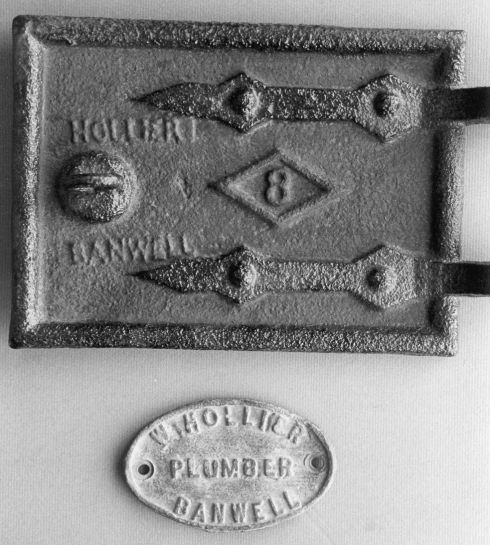
From 1872 right through to 1897, William Hollier is shown in Kelly's Directory as a Plumber, Gas Fitter and Decorative Painter, while the censuses describe him as a Plumber, Painter and Glazier. Quite an all-round craftsman and it appears his skills also extended to producing (presumably in cast iron) this grate door found in East Street, Banwell:-
Our next snapshot of the village comes from the 1881 census. By that time, James and Caroline have moved to Bristol to follow up the tailoring business in the city, leaving their son James lodging in the village as a Miller. (I believe James may have died soon after in 1883). William and Eliza are still present at Banwell with 4 of their family: Mary, William Thistle, Rosina and Ellen Elizabeth. They had lost their other daughter Sarah in 1877. Once again, they had a Nephew with them; this time it was William Payne.
Ten years on in 1891, William and Eliza are still at Banwell, but William Thistle had just been married to Kate Brake Hemmens and was probably now playing a major role in his father's plumbing business. William & Eliza's daughter Mary was working in Brisol as a confectioner's assistant in Clifton, experience which was to come in useful later on, as we will see. But the biggest change is the arrival in the village of John and Phoebe Hollier, an elderly couple aged 59 and part of the main ‘Somerset Hollier’ group. John had been born in 1832 in Rickford, Burrington. In 1850 he married a Banwell girl, Phoebe Hillman and had 5 children, the last, Albert, as late as 1871. Over the years, John & Phoebe had frequently moved, presumably wherever John could find work as an Agricultural Labourer. In 1851 they are found in Whitehall, Puxton, though their first son James (who doesn't appear in later censuses) had been born just 2 months before in Worle. I have not located John & Phoebe in the 1861 census, but in 1871 they are at Congresbury with sons Alfred and Charles. Why their 12 year old Edward isn't there too is a mystery. Their daughter Mary Jane was a Domestic Servant in Yatton.
In 1881, they are still at Congresbury, but this census has a number of problems. Firstly, Phoebe is called Kate and son Edward is called Edwin (actually this is a frequent variant for Edward). But John is described as ‘John Hollier, Senior’, while living next door is a ‘John Hollier, Junior’. Initially, this led me to assume that John junior was the son of John senior, but the facts didn't seem to support this. In the end, I discovered that John & Phoebe's daughter Mary Jane had married her second cousin John Hollier in 1880, so John junior was son-in-law of John Senior.
So back to 1891. John and Phoebe had moved to Banwell, Phoebe's birthplace. They had their late last child Albert with them (aged 20) and a 7 year old Grandson John. This may be Edward John born 1883, but parents are unknown. At 59, John was still working as a labourer. In 1897, Phoebe died and so by the time of the 1901 census, John is alone, but still in the village.
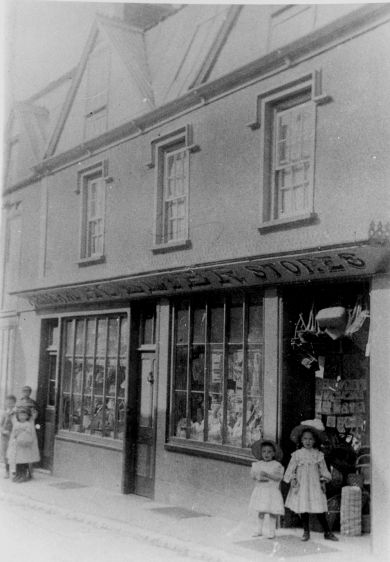 |
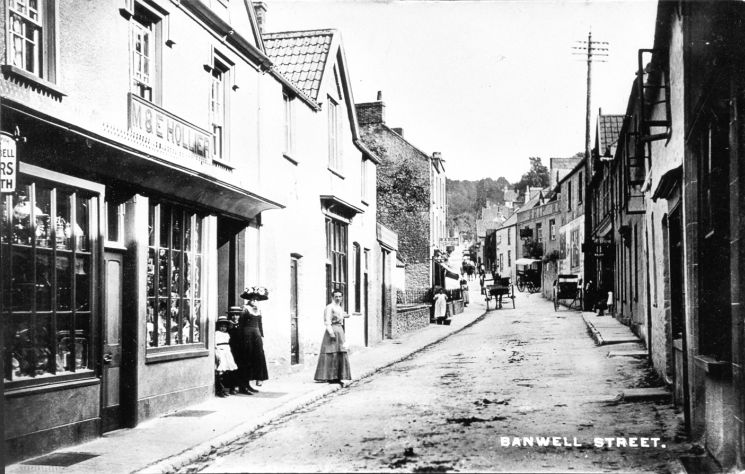
By 1901, much had changed in the Fordingbridge family too. Eliza had died in 1893 and her husband William in 1899. William Thistle Hollier is now the bread-winner and he and Kate have a family of 4. From 1902, Kelly's show William Thistle Hollier as the Plumber and Gas Fitter and this continues until 1935. William's two sisters, Mary and Ellen, are living next door and are now jointly running a shop, described as being an Ironmonger and Fancy Goods Shop. (Left) Mary and Ellen's shop (‘General Stores’). It seems likely that the children are William and Kate's, in which case the date would be around 1905. (Below) “M & E Hollier” is on the sign over the shop in this later view, possibly just pre-WW1. |
The widowed John Hollier died in 1908, so the village reverted to a ‘One Hollier’ community again. William Thistle and Kate lived in the village until William's death in 1944. Kate died in 1950 in the Crossway Nursing Home in Weston-Super-Mare. Both are buried in Banwell.
What about Wrington?
There was another Somerset village, Wrington, with two Hollier families who didn't think they were related. In 1901, the two families were Henry & Mary Ann Hollier and their 7 children, and Charles & Fanny Hollier and their 6 children. Henry was born in Rickford while Charles was born in Churchill. But I was not persuaded that they were unrelated, even if they weren't aware of a connection at the time. Charles's ancestry was easily put together - well easy once I had realised that there were two Somerset Hollier families with parents Charles and Fanny - but Henry proved far harder. On his marriage certificate of 1882, he claimed to have been the son of “John Hollier”, a Farmer's Labourer. But I could find no such John. Henry's date of birth, taken from his marriage certificate would have been 1859, while the 1881, 1891 and 1901 censuses would indicate 1861. The birth indexes show no such birth being registered around these times. But there is an intriguing baptism entry at Burrington in 1859 for a Henry Hollier, son of Martha Hollier, spinster. I believe that this is our Henry and that he covered up his illegitimacy on his marriage certificate like so many others in that situation. I was finally able to prove my hunch right when I found Henry using the name Henry Dowdey, living with his mother Martha Dowdey and his step-father John Dowdey in the 1871 census - made even more difficult to find by the name being incorrectly transcribed by the original enumerator as Dowden. So finally, it would appear that Charles and Henry were actually second cousins. Maybe Henry insisted that there was no relationship, so as to avoid any wider knowledge of his circumstances. In closing, it is worth mentioning that in both the 1881 and 1891 censuses, Henry was working in the Iron industry in Ebbw Vale in Wales. In 1901, he was a bricklayer's labourer, which at 40 was perhaps a less stressful occupation.
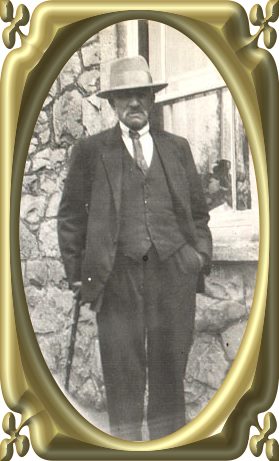
Henry Hollier at Wrington in the 1930s.